
Coastal Risk News & Press

B-Resilient – Future of Value
Watch the B-Resolient: Future of Value video

Turning Routine Retrofits into Strategic Resilience Investments
Most hazard and climate risk vendors stop at “assessment to reporting.” They deliver data, maps, and scores—but leave stakeholders stranded at the decision-making threshold. RiskFootprintTM solves this problem by bridging the gap between exposure data and actionable insight, empowering commercial real estate (CRE) professionals to make better informed “go/no-go” decisions on resilience retrofits.
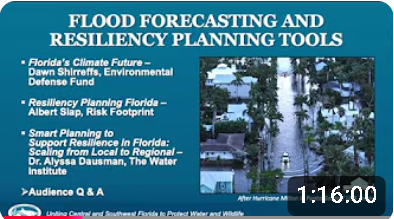
Flood Forecasting and Resiliency Planning Tools
Climate change refers to long-term shifts in temperatures and weather patterns. Human activities have been the main driver of climate change, primarily due to the burning of fossil fuels like coal, oil and gas.

‘All Hands on Deck’: King Tides Return as Hollywood Works to Stay Above Water
As groundwater levels creep upward and traditional drainage systems become overwhelmed, the Florida Department of Transportation is working on new climate-resilient infrastructure projects designed to protect one of the region’s busiest coastal roads.

From Assessment to Certification: The RiskFootprint™ B-Resilient™ Six-Step Process.
Purpose of the Six Step process – The B-ResilientTM Six Step Process provides large building owners with a disciplined system to manage their core assets from initial assessment and regulatory reporting on to needed resilient retrofit and even certification of completion.

RiskFootprint™ Leverages the FEMA National Risk Index and Hazus
Excited to share a video highlighting how the RiskFootprint™ hazard/climate assessment utilizes extensive data and modeling from FEMA’s National Risk Index and Hazus Damage/Loss software. Discover how this tool empowers informed decisions for resilience and supports the implementation of the new ASTM Property Resilience Assessment.

From National Risk Index to Hazus: Building Resilient Decisions with RiskFootprint
Every building faces risks from natural hazards — but understanding how much risk is the first step to protecting investments and strengthening resilience.

EBA Journal: Summer 2025 Edition by Envirobank
As is prudent, owners/investors need to determine if there may be a positive ROI or Benefit/Cost in resilient retrofits. ROIs may include damage prevention, fewer business interruptions, greater tenant satisfaction, maintaining market values, and, last but not least, insurance premium lowering or stabilization in the future

Meeting the Moment: How the New ASTM Property Resilience Assessment Standard Aligns the Needs of Commercial Real Estate and Insurers in a Changing Climate
What do commercial real estate owners and their insurers need in the face of climate-driven risk and increasing insured losses—and how does the new ASTM Property Resilience Assessment (E3429-24) meet those needs?

“RiskFootprint™ Provides What is Needed to Comply with LEED v5 Climate Resilience Assessment
In April 2025, the U.S. Green Building Council (USGBC) ushered in LEED v5, a transformative update to its green building rating system. For the first time, climate resilience is not just an optional add-on – it’s a core requirement

Comparing Hazus-Based Value-at-Risk and Climate Value-at-Risk in Resilience Planning
Resilience planning for buildings and infrastructure increasingly relies on quantitative risk assessments to guide investment in mitigation and adaptation. Value-at-Risk (VAR) frameworks have emerged as key tools for estimating potential losses from natural hazards.

The RiskFootprint™ Approach to Achieving Property Resilience
A Practical and Effective Process for Implementing the New ASTM Property Resilience Assessment Standard (E 3429-24)

The ASTM Property Resilience Assessment Standard and RiskFootprint™ Podcast
The ASTM Property Resilience Assessment Standard and RiskFootprint™ Podcast

Use of Flood Risk Data and Modeling in Commercial Loan Underwriting and How This May Evolve with Promulgation of the ASTM Property Resilience Assessment (PRA)
With the new ASTM Property Resilience Assessment (PRA) “best practice”, commercial lenders will now be exposed to property-specific, flood mapping covering many more types of flooding than FEMA flood maps provide, over wider areas of the US, and in much greater levels of detail

Uncovered — The 30-Year Mortgage Wasn’t Designed for Climate Chaos as House-demolishing, Weather Becomes Increasingly Common, More Americans Will Find Themselves Without a Safety Net.
It sounded like artillery, an infiltration of a quiet suburban community in the dead of night, as Kevin Pelley stood in the dark in what was left of his yard on a bank of the Puyallup River. A combat Army veteran who served in Kuwait and Iraq

RiskFootprint™ Enhances Hazard and Climate Assessment Technology with Cutting-Edge USGS Landslide and WRI Water Stress Models
RiskFootprint™ Enhances Hazard and Climate Assessment Technology with Cutting-Edge USGS Landslide and WRI Water Stress Models

EBA Journal: Summer 2024 Edition
The forthcoming ASTM Property Resilience Assessment Guide provides an overview of a generalized, systematic approach for conducting a Property Resilience Assessment (PRA) consisting of, first, identifying the natural hazards likely to affect a property; next, evaluating the risks posed by those hazards along with the capacity of the property to prepare for, adapt to, withstand and recover from those hazards; and then finally, identifying conceptual resilience measures to enhance property-level performance and recovery.
EBA ESG Webinar: Physical Climate Risk Screenings: Tackling Stage 1 of the Property Resilience
This disclaimer applies to any EBA member call or EBA hosted webinar, associated documents, information or opinions obtained from or ancillary to the Webinar. You are advised to read this disclaimer carefully before accessing, participating in, reading or making any other use of an EBA Webinar or member call

RiskFootprint™ Announces Enhancements to Further Elevate Water Risk Intelligence
BOCA RATON, FL, UNITED STATES, May 6, 2024 /EINPresswire.com/ -RiskFootprint™, a leading provider of flood, natural hazard, extreme weather, and climate change risk assessment solutions

Miami Shores Press Release
Coastal Risk Consulting, a leading, Floridabased climate risk assessment firm, has been selected to update the Sea Level Rise Vulnerability Assessment for the Miami Shores Village in Miami-Dade County, Florida