

A. Background:
The new ASTM Property Resilience Assessment standard (E-3429-24), titled “Standard Guide for Property Resilience Assessments,” provides a systematic approach for conducting Property Resilience Assessments (PRAs). The guide is intended to be used voluntarily and can be applied to existing buildings, new construction, substantial renovations, and various structures and infrastructure. and improve property resilience. The PRA is a property-level assessment process to inform decision-makers such as real estate investors, owners, operators, lenders, and nsurers, of current-day risks from floods, other natural hazards, and extreme weather impacts, including those exacerbated by future climate change, which may affect a property or portfolios of properties. It aims to help decision-makers understand physical climate risks with a goal of enhanced property-level resilience leading to preservation of property value, improved occupant safety, reduced disruption, or other user goals.
Three separate stages have been identified in ASTM’s Standard Guide for PRAs:
Stage 1: Identifying the property’s exposure to floods, other natural hazards, extreme weather and climate change impacts likely to affect a property.
Stage 2: Evaluating the risks posed by those hazards and the property’s capacity to prepare for, adapt to, withstand, and recover from those hazards. This includes vulnerability to the identified hazards and values-at-risk. Stage 2 of the PRA includes, at minimum, a baseline assessment of safety, damage, and functional recovery time, and a limited consideration of community resilience or other material dependencies, such as the ability of utilities to deliver service to a property following a hazard event. And, 2385 NW Executive Center Drive, Suite 100 Boca Raton FL 33431
Stage 3: Identifying feasible resilience measures to enhance property-level performance and recovery and rough order of magnitude costs (ROM). Based on the identified resilience goals for the target property and available information, the PRA professional will identify basic measures that can be employed to improve resilience. These resilience measures should be appropriate and actionable considering various parameters such as the identified planning time horizon, the useful life of the target property, the criticality of the property, performance and
recovery expectations, and the needs of the user and occupants. Consideration of these parameters will guide the user to evaluate and prioritize specific resilience measures to be implemented.
Each stage of the PRA is separate, and the client can choose to do one stage, two or all three stages.
Resilience, as defined by ASTM Guide E3341, is “the ability to prepare for anticipated hazards, adapt to changing conditions, to withstand and limit negative impacts due to events, and to return to intended functions/services within a specified time after a disruptive event.”
NOTE: In some cases, basic resilience measures may not exist and advanced engineering and design solutions beyond the scope of a PRA may be needed. It is important to note that the PRA is an initial assessment approach that typically may not get to the level of detailed engineering, architectural, or scientific recommendations and designs. However, such recommendations and designs may arise at a high-level during Stage 3.
The PRA is not intended to be a certificate of resilience or compliance, rather its purpose is to facilitate more informed decisions at the property level.
B. The RiskFootprint™ Approach:
1. Overview of the PRA

2. Stage 1 = Hazard Screening (RiskFootprint™)
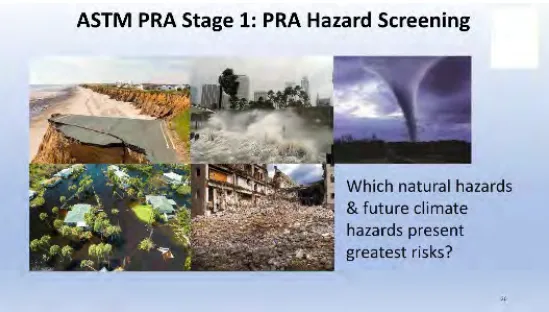
Steps in Stage One – Evaluation will be made of the subject property to identify hazard exposures to specific and vital building components and infrastructure. It is important to note that the hazard exposures at this stage will be assessed by using desktop methods, models, and
mapping, without the time and expense of field studies and sampling. This will include:
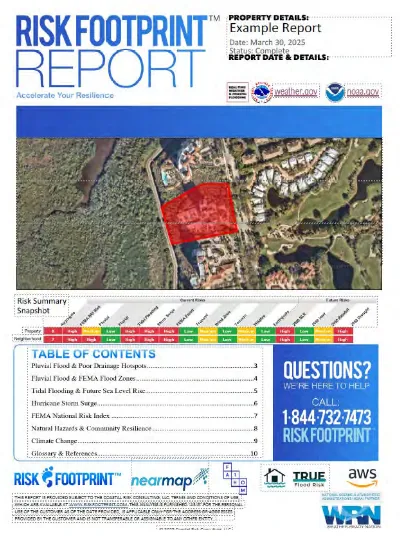
• Providing a RiskFootprint™ Hazard/Climate assessment report for the building and property. The RiskFootprint™ report satisfies the exposure assessment requirements of ASTM PRA Stage One. An optional Stage 1a task involves further desktop research to determine if any applicable
state, regional, or local hazard assessment models exist, which may shed more light on the property’s risks from exposures to the hazards.
• Requesting and reviewing pertinent, client-provided documentation, including prior damage information, site-specific studies, insurance claims, and “as-built” drawings, etc.
• Interview building managers, stakeholders, and others to obtain relevant background information.
• Meet with client to determine if client wants to involve its insurance agent and insurance providers in the PRA process to potentially stabilize and/or lower annual insurance costs. If so, meet with client and insurance providers to discuss the PRA approach and potential for loss
exposure and insurance premium reductions. This process can extend through the full property resilience assessment and implementation of resilience measures.
• Meet with client to discuss the resilience of surrounding governments (local, county, state, federal) and the community, including their infrastructure and utilities, and how the resilience of the community, or lack thereof, may help or hinder client’s efforts to make its building(s) safer and more resilient – now, and in the future. If requested, we will provide a separate proposal for a more in-depth Community Resilience Study.
• Meet with client to determine its risk tolerance, building performance goals, and the level of resiliency being sought relative to a specified hazard’s severity, and likelihood. Client will identify goals in terms of damage/loss to structure, contents, and business interruptions, and risk tolerance.
DELIVERABLE: Utilizing scientific method and models, we will create a report including maps, highlighting areas of concern relative to exposure to floods, natural hazards, extreme weather, and future climate change impacts. After submission of the Stage 1 report, we will meet with
client to determine next steps and, if client wants to proceed to Stage 2.
Stage 1 Deliverable – The RiskFootprint™ Report
” THE WHAT”
3. Stage 2 = Vulnerability and Value-at-Risk

Steps in Stage 2 – Utilizing the RiskFootprint™ exposure data and the information and documents reviewed in Step One, Coastal Risk Consulting will initially identify vulnerabilities relating to specific building systems, equipment, and infrastructure. – Vulnerabilities may be for any hazard identified in the RiskFootprint™ or for those specifically selected by Client. These vulnerabilities will be assessed for both severity and
likelihood.
– We will also estimate the potential damage/loss and restoration periods/times that would likely be associated with the identified hazards, event levels of severity, and likelihood. The vulnerability and loss estimates in Stage 2 are based on the current conditions of the site,
without any planned or future protections that may be identified in Stage 3.
– Stage 2 quantification of vulnerability and value-at-risk modeling (a percentage of replacement costs for structure and contents) can be provided for floods, hurricane winds, earthquakes, and tsunamis. Qualitative estimation of vulnerability and values-at-risk can
be provided for many other hazards, as needed.
– In Stage 2, we will employ the Hazus model, which is a GIS-based natural hazard loss estimation model developed by FEMA. It is used to estimate potential damage and economic losses from extreme events such as earthquakes, floods, hurricanes, and tsunamis. Hazus integrates geographic information system (GIS) technology to analyze risk and support decision-making. Hazus employs probabilistic and scenario-based modeling to assess impacts on buildings, infrastructure, and populations. The model includes different modules tailored to specific hazards, such as the Hazus Earthquake Model, Hazus Flood Model, and Hazus Hurricane Model, each designed to simulate damage and loss estimates based on hazard intensity and exposure. Hazus is a widely respected tool for disaster risk assessment.
– When using Hazus in ASTM Property Resilience Assessment Stage 2, it is important to ensure high-quality input data and expert interpretation, which will be key to maximizing its effectiveness.
When the report on Stage 2 is completed, another meeting with client will take place to discuss damage/loss estimates for structure and contents, recovery times by event scenario, and potential business interruptions. Another meeting can also take place at this point with
the client’s insurance providers. Client will determine at this point if it wants to continue to Stage 3.